About Sooth

Sooth.fyi is a search engine that helps students identify high-quality results “without distractions from ads, dubious sources, or AI-generated content.” Its focused crawler is curated to retrieve reliable publishers of news, research, and data, as well as varied perspectives—even challenging or contradicting ones—that present reasoned arguments and reliable evidence, rather than unsupported assertions.
“I tell students that Sooth is an ‘academic search engine,’
knowing they’ll adore it as soon as they do their first search!”
Introducing Sooth to the School
I describe Sooth to teachers “as a human-curated search engine that organizes results into categories that take the guess work out of determining credibility,” says Cheri Dobbs, PreK3-12 Coordinator of Library Services, Upper School Librarian, and member of the Teaching and Learning Council at Detroit Country Day School (MI).
“I demonstrate a comparative search of AI, Sooth, and my databases to show that each has advantages,” writes Carolyn LaMontagne, Director of Libraries at Cate School (CA). “Throughout my whole career, I have been trying to have faculty require fewer sources and expect deeper engagement with them. Sooth makes this possible.”
“I justify Sooth’s added value to administration because we’ve gained access to The Economist and other subscriptions that are not within our collection development budget,” explains Mary Fraser, Library Department Head at Germantown Academy (PA). Honored by her school for distinguished teaching and program excellence, Mary has quickly recognized that “Sooth’s rating systems and Misinformation Toolkit provide jumping-off points for impromptu discussions about media literacy topics, such as why most mainstream search engines are broken.”
Assessing Sooth in the Classroom
Jillian Joyce, a social studies teacher, and Margi Putney, the librarian at Burr and Burton Academy (VT), have been testing Sooth’s value in a complex assignment that has been fine-tuned over time. Every spring, Jillian assigns a Federalism Case Study to her Honors Government class. Students are asked to choose, research and analyze an issue such as health care, education, or data security as it relates to the balance of policy and law-making powers distributed between the Federal and State Governments. The product is a two-page position paper with an annotated bibliography of 3-6 sources in NoodleTools.
This spring, Jillian and Margi decided to test Sooth’s capabilities during the federalism project. “Students are expected to identify and use government sources, local and state news,” Margie explains, “as well as ‘linkage institutions,’ which are entities that connect voters to the government and the voting process, such as political parties, voting rallies, lobbying organizations, and media.” Sooth’s curation process identifies reliable publishers through a dynamic vetting process and presents the results categorized by types of organization.
Potentially, students begin to recognize types of publishers, an attribute of what Nora Murphy calls “source literacy.” Rather than evaluating a source divorced of any publishing context, students assess information quality with an understanding of the norms of groups of publishing entities that have comparable information interests, communication genres, and objectives.
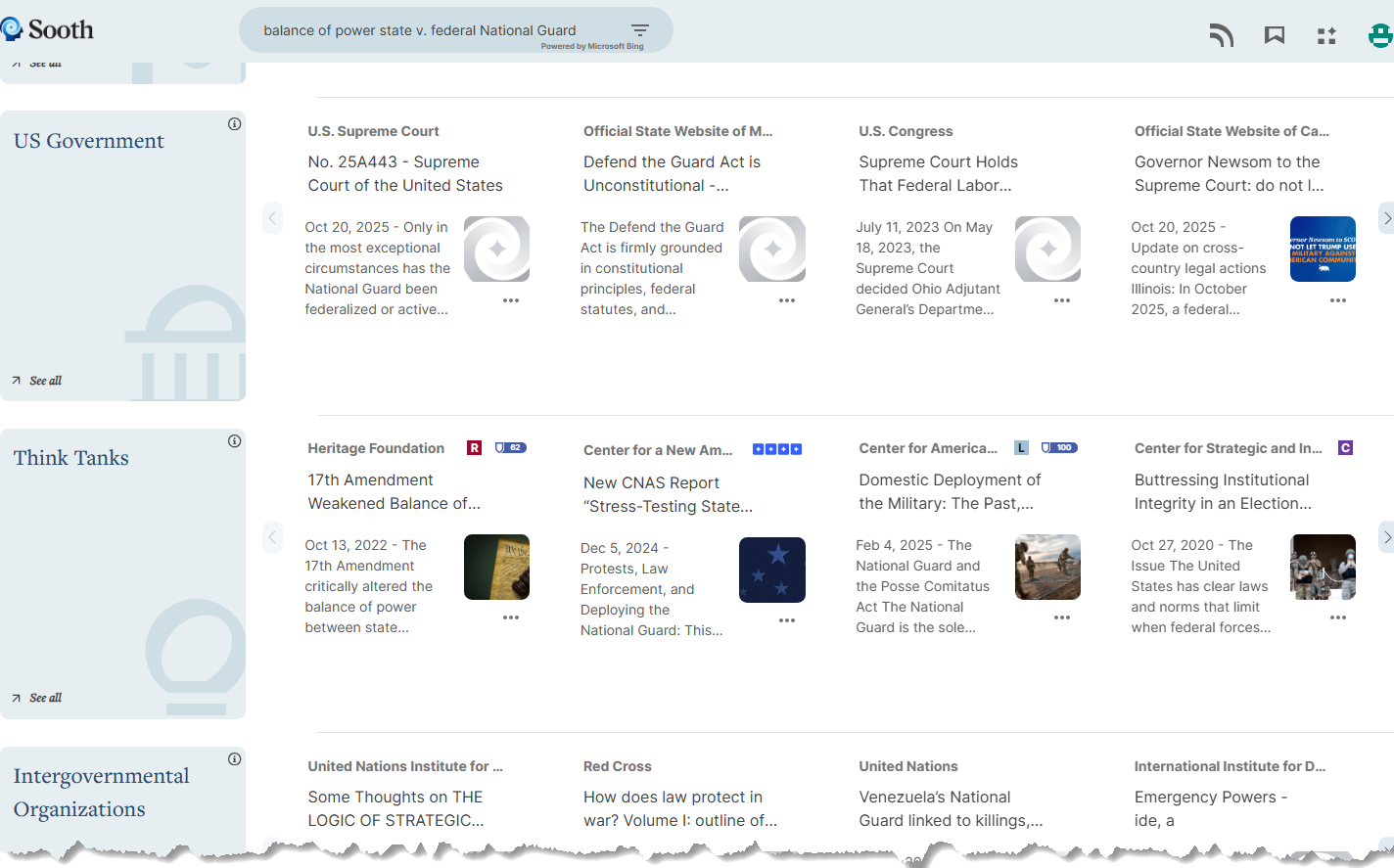
Sooth also juxtaposes ratings of two independent media-monitoring organizations that assess information using different standards. The first, NewsGuard, rates publishers on both journalistic criteria and transparent publishing practices. Students initially see a publisher’s summative reliability score and can click on the “Full Nutrition Label” to learn why a publisher has earned this rating. A recent academic research study confirmed that Sooth is a “stable and scalable method for identifying content coming from untrustworthy online sources.”
AllSides, the second source of ratings, sorts media outlets along the political spectrum into categories, e.g., Left, Lean Left, Center, Lean Right, Right. Their methodology integrates “multi-partisan Editorial Reviews by trained experts and Blind Bias Surveys in which participants rate content without knowing the source.”
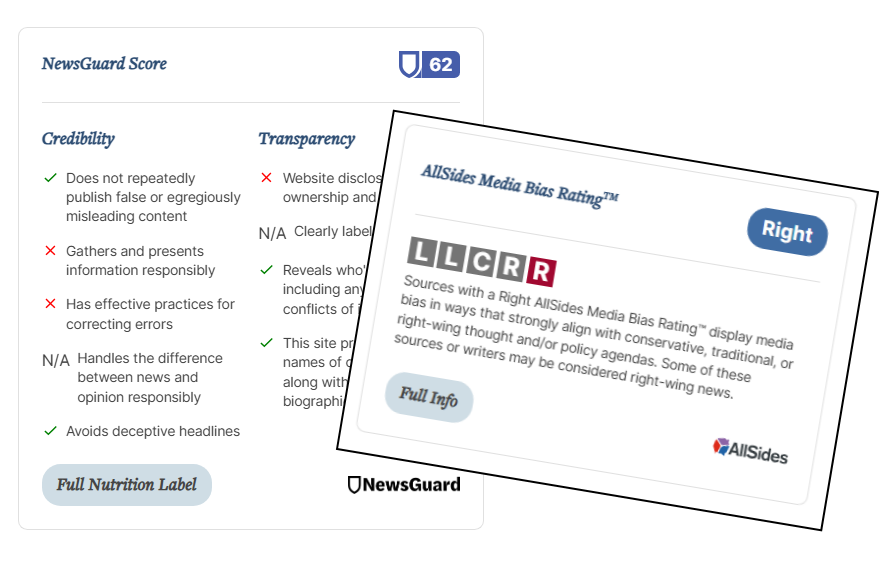
“Students are urged to find credible sources with different political perspectives. In past years, some students erroneously assumed that only one political side produced reliable work. When they use both rating criteria provided through Sooth they understand that the credibility of a source is separate from its political leaning,” Margi concludes.
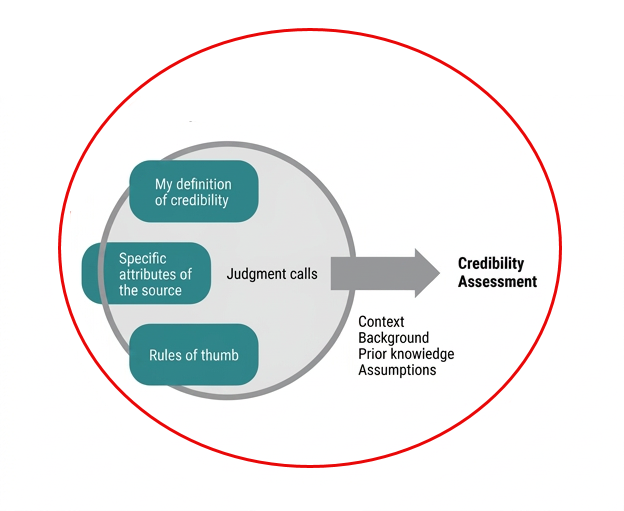
“Currently students are polishing their final projects which use information from government sources, a think tank, several news sources, and the SCOTUSblog which covers the Supreme Court’s work,” reports Margi. “I’m eager to see their annotated bibliographies and papers — I think they’ve learned a lot about credibility!”
Citing Sources from Sooth
To use the citation export feature from Sooth, open the NoodleTools project you want to work with in one browser tab. In a second tab, open Sooth and click the “…” icon associated with the article you are using. The side panel that opens provides access to bookmarking, citation, and reading levels.
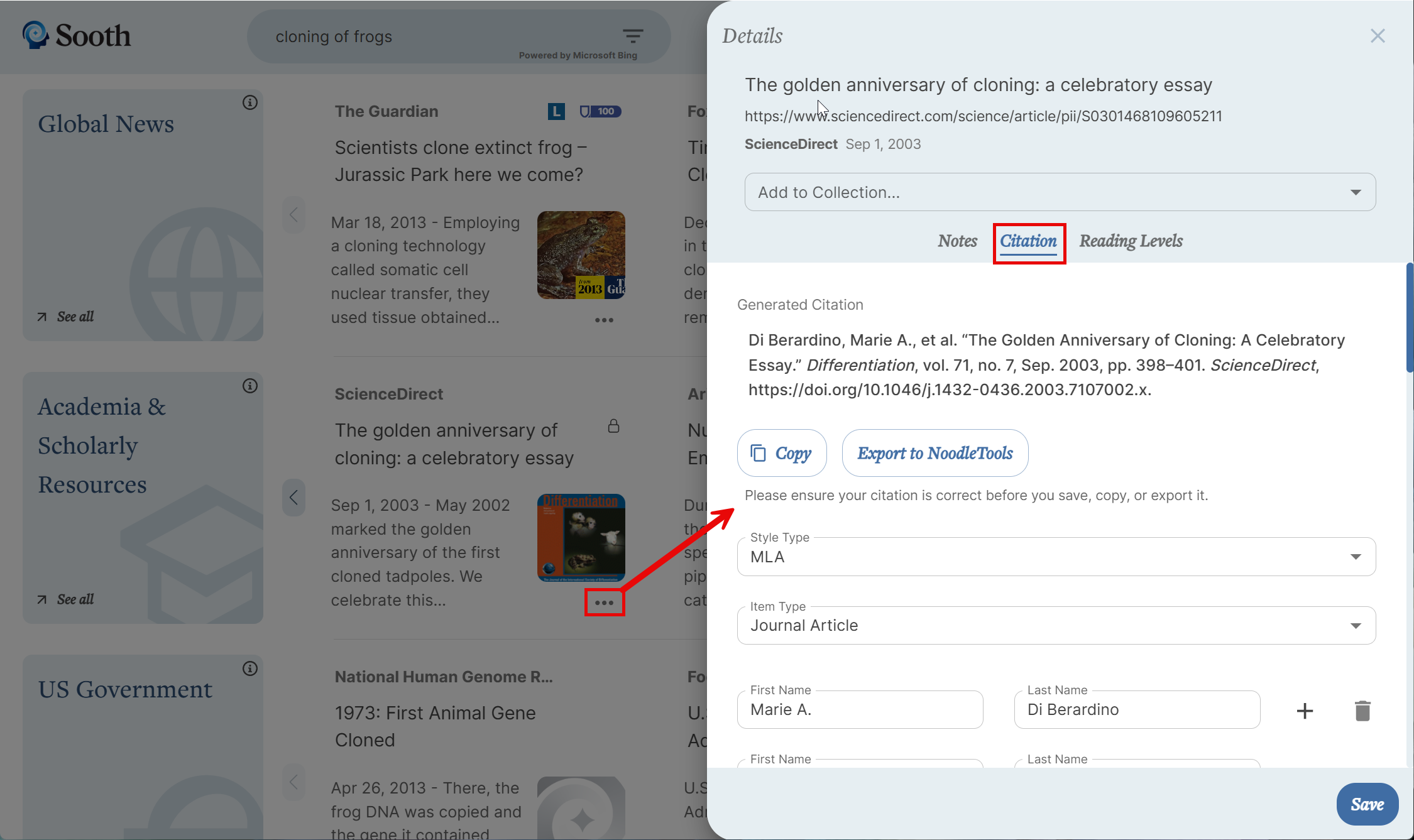
Click “Citation” to view the metadata they have collected about the article. Sooth may prompt you to fill in missing source information before continuing. When you are satisfied, click the Export to NoodleTools button.
Note: The imported entry will match the citation style of the NoodleTools project that you have open (not the citation format shown in the Sooth panel).